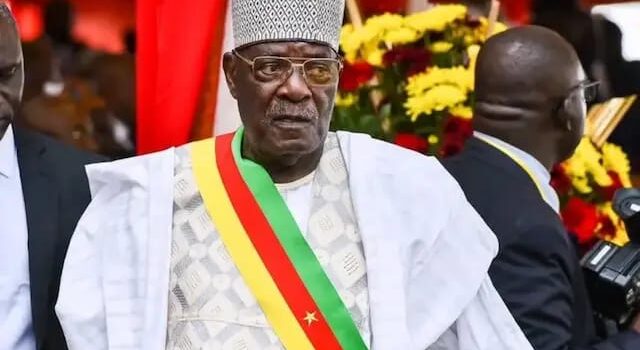
The former President of the National Assembly, Cavaye Yéguié Djibril, passed away on Wednesday May 6, 2026 in Mada, his birthplace in the Tokombéré district of the Mayo-Sava department in the Far North region. Passing away at the age of 86 following an illness, the politician leaves behind more than half a century of public life. He also spent almost thirty-four years at the head of the lower house of Cameroon's parliament.
A major figure in the national political landscape and an influential member of the CPDM, he has had a profound impact on Cameroon's political history. His unwavering commitment to republican institutions had a lasting impact on the country's parliamentary life. In keeping with Muslim tradition, the land of Mada closed in on him on the day of his death. His death thus brings to an end the career of one of the most influential men in President Paul Biya's regime. Born in 1940 in the Far North region, Cavaye Yéguié Djibril began his career after studying at the Centre régional d'éducation physique et sportive in Maroua. In 1963, he became a physical education and sports teacher. Two years later, in 1965, he was appointed Interministerial Inspector for the Far North. This position marked his entry into the administrative spheres of the State.
From single party to the perch of the National Assembly
June 7, 1970, Cavaye Yéguié Djibril entered the Cameroon Legislative Assembly under the colors of the UNC, the single party led by President Ahmadou Ahidjo. One year after the advent of the unitary state, in 1972, he was elected deputy to the National Assembly. He then joined the Assembly's bureau as quaestor. February 1975, At the UNC's second ordinary congress, he joined the party's central committee. After the legislative elections of May 1983, he became second vice-president of the National Assembly. A few years later, he temporarily left the parliamentary scene. He then served as assistant prefect in the Diamaré department. When the UNC became the RDPC in 1985, under the impetus of President Paul Biya, Cavaye Yéguié Djibril retained his place on the Central Committee. A loyal supporter of the regime, he gradually strengthened his influence within the state apparatus.
March 1992, With the return of multiparty politics and pluralist legislative elections, he regained his seat as a member of parliament. A few weeks later, on March 31, 1992, he is elected President of the National Assembly. He held this position without interruption for thirty-four years. From 1992 à 2024, he was re-elected thirty-two times to the presidency of the National Assembly. This record remains unmatched in Cameroon's parliamentary annals. At each legislature, the CPDM presented him as its natural candidate for the perch. His election becomes a political formality, given his experience and authority within the presidential majority.
A political patriarch of North Cameroon
One of the few episodes of protest occurred in August 2007. That year, the CPDM deputy Adama Modi announced his candidacy against him for the presidency of the National Assembly. Despite pressure from his party, the parliamentarian initially refused to withdraw. He finally left the room when the vote was taken. Cavaye Yéguié Djibril was re-elected with 130 votes out of 143 cast. This episode illustrates the political solidity and calm of the man many nicknamed «the man from the perch». During his long presidency, he regularly took a stand on a number of national issues. In November 2001, from the perch of the National Assembly, he publicly condemned secessionist tendencies in English-speaking regions. He stated that the parliamentary institution would not tolerate any threat to national unity. In November 2005, he also urged MPs to become more involved in the fight against corruption within public administrations.
Beyond politics, Cavaye Yéguié Djibril was also the Lamido de Mada. His position as traditional chief considerably strengthened his influence in the Far North. Many considered him to be one of the political patriarchs of northern Cameroon. In March 2010, he became honorary president of the National Forum of Traditional Rulers of Cameroon. On this occasion, he called on traditional chiefs to collaborate with the State. He also invited them to promote cultural values without taking the place of republican institutions. The forum also issues a statement encouraging President Paul Biya to stand for re-election in the 2011 presidential elections. For several years, Cavaye Yéguié Djibril is second only to the President of the Republic. However, the creation of the Senate in 2013 changed the order of protocol. This status now falls to the President of the Senate, without reducing his political influence.
A death that turns a political page
In 2026, his health gradually deteriorated. The authorities decided to evacuate him to South Africa. March 17, 2026, Théodore Datouo is elected President of the National Assembly. This election officially ends the thirty-four-year parliamentary reign of Cavaye Yéguié Djibril. Less than two months after stepping down, the former President of the National Assembly breathed his last in Mada, where it all began. His death also comes less than two months after that of Marcel Niat Njifenji, former president of the French Senate.
Anita MENOUNGA

 Français
  English